Meditation can feel surprisingly complex. There are many styles, many traditions, and many ways people describe what happens during practice. For someone exploring meditation — or deepening an existing practice — it’s easy to wonder how all these approaches relate to one another.
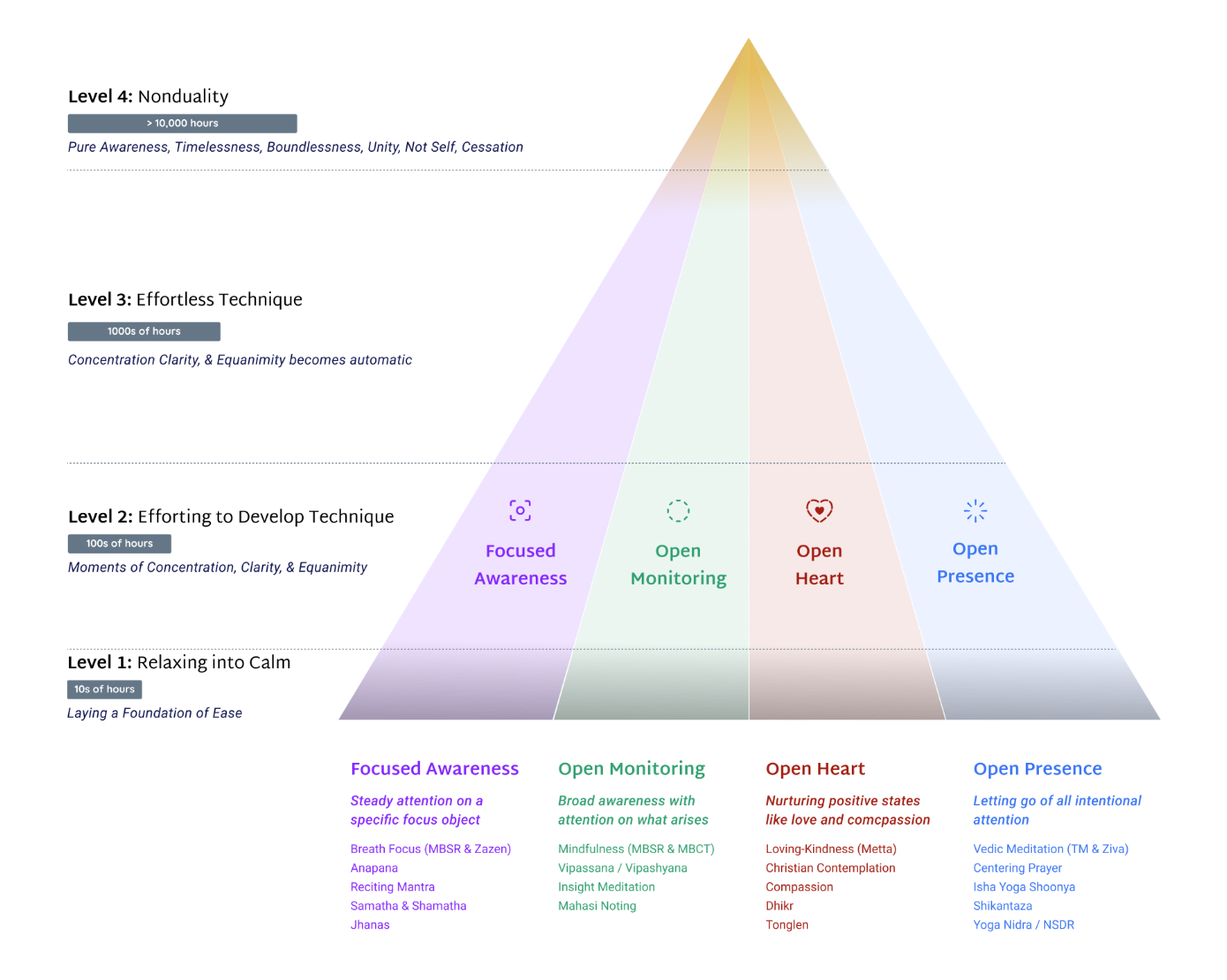
To bring clarity to that complexity, we use a simple pyramid. It’s a way of organizing meditation practices by the skills they train and the developmental stages that are common to all types of meditation. Along the base of the pyramid we list four categories of practice: Focused Awareness, Open Monitoring, Open Heart and Open Presence. Each trains different skills. Under each category are the names of common practices in that category.
-
Focused Awareness (FA) trains steadiness by staying with a single object
-
Open Monitoring (OM) turns down the impulse to judge or label every sensation
-
Open Heart (OH) practices like Metta shift perception toward warmth and connection
-
Open Presence (OP) softens the sense of separation between self and experience
Along the vertical axis are four developmental stages that apply to learning meditation in any style. Four styles x four developmental stages = 16 possible brain states. We show them as a pyramid because as you get more experienced, the brainwaves become more similar and blur into each other at the top.
This pyramid isn’t about ranking practices or suggesting that one style is better than another. Instead, it offers a map to help you understand how your current style fits into the big picture and what are the developmental stages that you will go through.
What is the Connecting Thread Across all Meditation Styles?
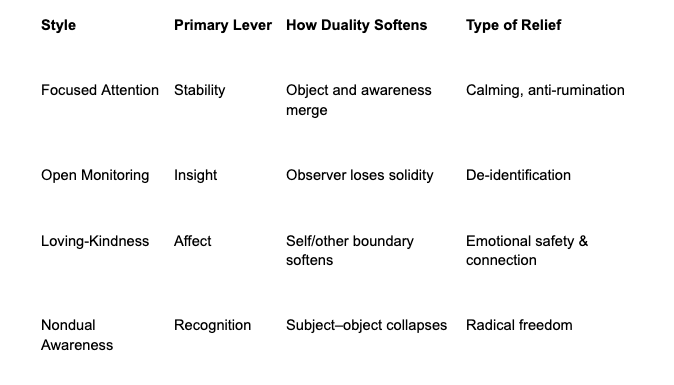
All meditation styles seek to reduce suffering by easing the rigid subject/object split between “me” and “what is happening”
Focused Attention (FA) meditations narrow attention to a single object and gently release everything else. Over time, attention stabilizes, effort drops and the sense of “I am focusing” fades. “Watching the breath” becomes “the breath breathing itself”
Open Monitoring (OM) meditations observe whatever arises—sensations, emotions, thoughts - without selecting or suppressing. As the subject/object distinction becomes less rigid, the “observer” becomes less solid, objects arise and pass without ownership, and the boundary between watcher and watched loosens. “I am anxious” becomes “Anxiety is arising and passing.”
Open Heart (OH) meditations cultivate warm, prosocial affect toward self and others. The sense of a separate, defended self relaxes, and others are felt from the inside, not as external objects “I am separate and threatened.” becomes “I am connected and included.”
Open Presence (OP) meditations point directly to awareness itself, without effort, focus, or manipulation. Over time the subject–object split is seen as a mental construction, awareness is experienced as prior to both and there is no center watching an object—only knowing. There is no separate self to defend and no object to cling to or resist. “I am aware of X” becomes “Awareness, appearing as X.”